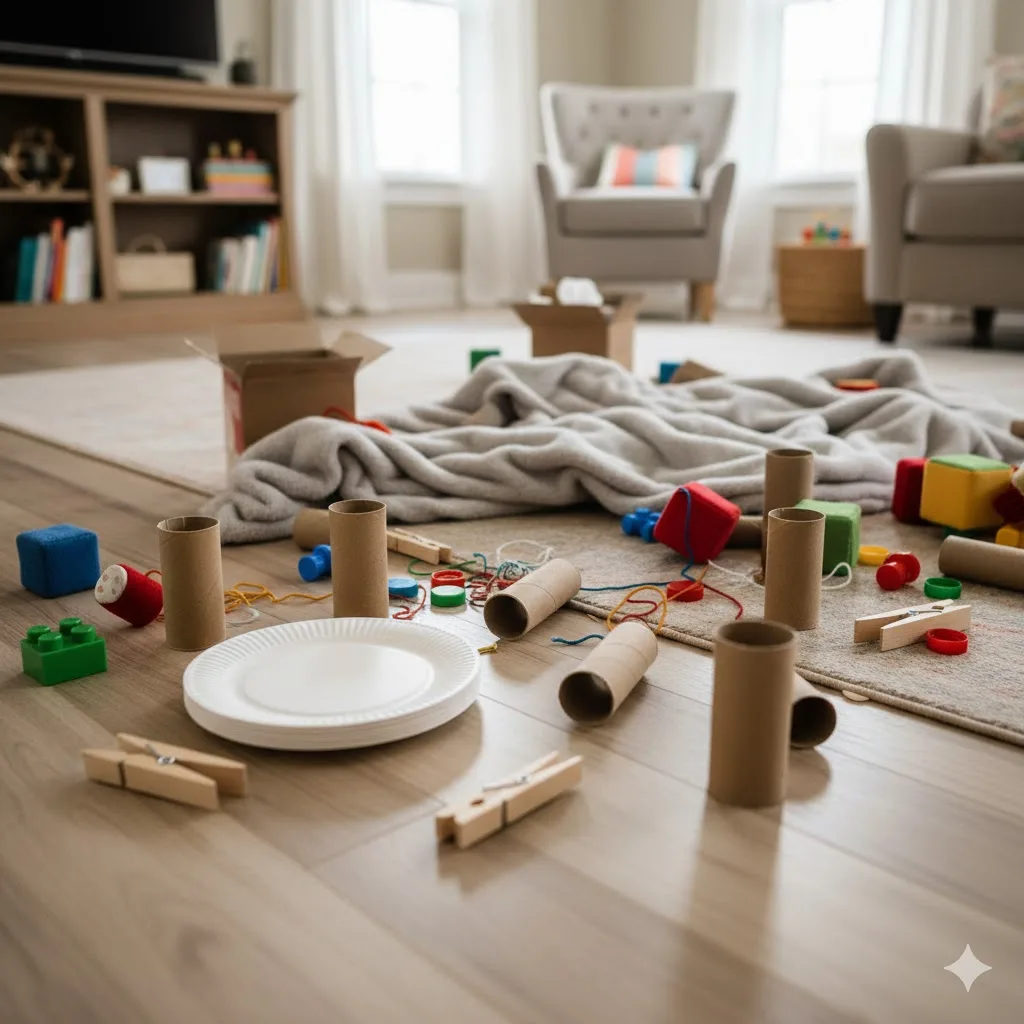
Open-Ended Play Ideas: 10 Household Items You Already Own
You don't need expensive toys to support your child's development. Some of the best open-ended play materials are already sitting in your kitchen cabinets, recycling bin, or junk drawer. This guide reveals 10 everyday household items that developmental experts love for fostering creativity, problem-solving, and sensory exploration in children ages 0 to 6, plus simple ideas for how to use them.
There's a certain irony that plays out in nearly every parent's living room: a pile of expensive, battery-powered toys sits ignored in the corner while your toddler loses their mind over the cardboard box it came in.
It turns out, your kid isn't broken. They're actually onto something.
Open-ended play, the kind where there's no right answer, no winning, and no instructions, is some of the richest developmental work a young child can do. It builds executive function, creativity, and language. And the best materials for it? You probably already own them.
Here are 10 items hiding in your home that are genuinely great for open play.
1. Cardboard Boxes
The classic for a reason. Boxes become caves, cars, rockets, beds for stuffed animals, and stages for puppet shows. For babies, a small box with a few objects inside makes a satisfying container activity (in, out, in, out, forever). For older kids, offer tape and markers and just step back.
Developmental win: Spatial reasoning, imaginative play, fine motor skills.
2. Muffin Tins
These are an underrated sorting and counting goldmine. Fill the cups with pom poms, dried beans, small rocks from the backyard, or blocks of different colors. Give your child a spoon or tongs and let them transfer, sort, and arrange to their heart's content.
Developmental win: Fine motor control, early math concepts, concentration.
3. Scarves or Fabric Scraps
Lightweight scarves (or even old t-shirts cut into squares) are endlessly versatile. Babies love the sensory experience of different textures. Toddlers use them as capes, blankets for dolls, or peek-a-boo props. Older kids incorporate them into elaborate imaginative scenarios.
Developmental win: Sensory exploration, dramatic play, body awareness.
4. Dried Pasta and Beans
A bin of dried pasta shapes or a bowl of dried beans is a low-cost sensory bin that keeps many kids busy for a surprisingly long time. Add scoops, funnels, small cups, or toy figures. (Note: supervise closely with children under 3 due to choking risk, or use larger pasta shapes.)
Developmental win: Sensory processing, early science concepts like volume and weight, imaginative play.
5. Pot Lids and Wooden Spoons
Yes, it will be loud. But banging pot lids together and drumming on overturned pots is a legitimate musical and physical experience for young children. They're exploring cause and effect, sound, and rhythm. You can make it slightly less chaotic by offering just one pot and one spoon at a time.
Developmental win: Auditory exploration, cause and effect, gross motor coordination.
6. Paper Bags
Lunch bags and grocery bags are wonderful open-ended materials. Kids stuff them, wear them as masks (with your help cutting eye holes), use them as puppets, or fill them with "treasures" from around the house. Crinkle them for babies who love sound and texture.
Developmental win: Fine motor skills, dramatic play, sensory exploration.
7. Ice
Freeze water in different containers (ice cube trays, muffin tins, small bowls) and let your child explore them in a tray or sensory bin. Add food coloring to make it more visually interesting. Older kids love "excavating" small toys frozen inside blocks of ice using droppers filled with warm water.
Developmental win: Sensory processing, early science concepts, problem-solving.
8. Tape
A roll of painter's tape is practically a curriculum on its own. Put tape lines on the floor for a balance beam or road for toy cars. Give your child a piece to stick and unstick. Let them tape scraps of paper together. Older kids can use it to build structures or create their own artwork.
Developmental win: Fine motor skills, spatial reasoning, creative problem-solving.
9. Measuring Cups and Spoons
In the water table, sandbox, or even just a big bowl of water at the kitchen sink, measuring cups become some of the most engaging math manipulatives around. Kids explore volume, practice pouring and coordination, and engage in scientific thinking without realizing it.
Developmental win: Early math concepts, fine motor skills, scientific reasoning.
10. Old Magazines and Catalogs
For kids 2 and up, a stack of old magazines is a treasure trove. They can tear pages (deeply satisfying and great for hand strength), cut with toddler scissors, sort pictures by color or category, or create collages. Ask them to find all the dogs, or everything red, for a simple language-rich game.
Developmental win: Fine motor strength, language development, visual discrimination.
A note for parents: You don't need to set any of this up perfectly or facilitate it with enthusiasm you don't have. The beauty of open-ended materials is that they do the work. Your job is just to offer them and get out of the way.
That's kind of the whole secret.
Looking for one simple, developmentally rich activity every day, tailored to your child's age? That's exactly what Puffling is for.
Ready to make playtime magical?
Get personalized play ideas for your child in seconds.
Download Free