Computational Thinking Skills for Kids 0-6: How Everyday Play Already Builds Future-Ready Brains
If you have ever watched your toddler sort their snack cup by color, or your preschooler insist on the exact same bedtime sequence every single night, you have already seen computational thinking in action. The phrase sounds intimidating, almost like something reserved for kids in coding camps. It is not. Computational thinking is a way of solving problems that any human brain can do, and the research is clear that the foundations start forming in your child long before they ever touch a keyboard.
Here is the reassuring part: you are not behind. You do not need flashcards, apps, or expensive toys to build these skills. You need ordinary playtime, ordinary conversations, and the steady presence of an adult who knows your child. That last part is you.
The Short Version
Computational thinking is made up of four problem-solving skills: decomposition, pattern recognition, abstraction, and algorithmic thinking. All four show up naturally in early childhood play, from peekaboo to pretend kitchen to "you be the customer and I be the dog doctor." You are almost certainly already nurturing them. This guide just helps you notice.
What Is Computational Thinking, in Plain Language?
Computer scientist Jeannette Wing brought the term "computational thinking" into the mainstream in a 2006 essay, describing it as a problem-solving approach that draws on ideas from computing but applies to everyday life. Since then, researchers like Marina Bers, who leads the DevTech research group at Boston College and authored Coding as a Playground, have shown that young children can develop these skills through play, well before they are ready for any kind of formal programming.
The four core skills are:
- Decomposition: breaking big things into smaller things
- Pattern recognition: noticing what repeats
- Abstraction: focusing on what matters, ignoring what does not
- Algorithmic thinking: figuring out the steps to do something
Your job is not to teach these in a formal sense. It is to notice when your child is doing them and to gently make space for more.
1. Decomposition: Big Problem, Smaller Pieces
Decomposition is the skill of taking something overwhelming and breaking it into chunks you can actually handle. Adults do this constantly. Packing for a trip becomes clothes, toiletries, electronics, snacks. Kids do it too, even if it does not always look like it from the outside.
What it looks like by age:
- Babies and toddlers (0–2): Your one-year-old gets a stacking cup tower wrong, knocks it down, and starts again with one cup at a time. They are intuitively breaking the task down.
- Preschoolers (3–4): "First we get the bowl, then the cereal, then the milk." Your child narrating their breakfast is decomposition out loud.
- Older preschoolers (5–6): Building a fort involves separating "find the blankets," "move the chairs," and "make a door." That is sophisticated stuff.
Easy ways to nurture it:
When your child is stuck, you can gently ask, "What is the first part?" instead of jumping in with the whole solution. Cooking together is decomposition in its most delicious form. Even cleanup becomes a thinking opportunity if you ask, "Should we start with the blocks or the books?"
You know your kid. Some children love to plan out loud, and some prefer to work it out silently. Both count.
2. Pattern Recognition: Noticing What Repeats
Pattern recognition might be the earliest computational thinking skill of all. Foundational research by Jenny Saffran and colleagues at the University of Wisconsin found that infants as young as eight months old can pick up on statistical patterns in the sounds around them, using those patterns to start figuring out where words begin and end in continuous speech. Your baby has been a pattern detective from very early on.
What it looks like by age:
- Babies (0–12 months): They light up at the predictable "boom" in peekaboo. The pattern is the joy.
- Toddlers (1–3): They notice that the same song means bath time, that one shoe goes on each foot, that pulling the cat's tail leads to the same unhappy outcome every time.
- Preschoolers (3–6): They start creating their own patterns. ABAB color sequences with crayons, repeating beats with kitchen pots, predictable storylines in their pretend play.
Easy ways to nurture it:
Sing the same songs, often. Repetition is not boring to a young brain. It is fuel. Point patterns out loud as you see them: "Look, red, blue, red, blue. What do you think comes next?" Read books with predictable refrains and let your child fill in the blanks.
If your child suddenly notices a pattern you never pointed out, take a beat to notice it with them. That little moment of "I see something" is the foundation of analytical thinking.
3. Abstraction: Keeping What Matters, Letting Go of the Rest
Abstraction is the skill of pulling out the important details and ignoring the rest. It is what lets your child draw a person as a circle with two stick legs and call it Grandma. The drawing is not photorealistic, and that is the point. Your child has identified what makes Grandma recognizable to them and stripped away everything else.
What it looks like by age:
- Toddlers (1–3): A banana becomes a phone. A blanket becomes a cape. Symbolic play is abstraction in its earliest form, and decades of developmental research link rich pretend play to later cognitive growth.
- Preschoolers (3–5): Drawings, stories, and pretend play all involve choosing which features to keep. "This is a house" might be one square and one triangle, and that is exactly enough.
- Older preschoolers (5–6): They start to build categories. "Vehicles" suddenly includes trucks and helicopters and the weird thing they saw at the construction site. They are abstracting the essential features.
Easy ways to nurture it:
Encourage pretend play and resist the urge to correct it. A spatula can absolutely be a sword today. Ask "what makes a dog a dog?" kinds of questions. The answers will surprise you. Look at simple icons together (the bathroom sign, the recycling symbol) and talk about what they represent.
If your kid's drawing of you has three eyes and no nose, that is not a mistake. It is an artistic choice, and probably a developmental one too. You know what they were going for.
4. Algorithmic Thinking: Step by Step
Algorithmic thinking is the ability to work out a sequence of steps that gets you from A to B reliably. In her work on coding and child development, Marina Bers describes how young children can plan and execute simple sequences when given developmentally appropriate tools, and how this kind of sequencing supports executive function and self-regulation more broadly.
What it looks like by age:
- Toddlers (1–3): Routines are early algorithms. Bath, pajamas, books, bed. Your toddler insisting on the same order every single night is not just stubbornness. It is them mastering a sequence.
- Preschoolers (3–5): They can follow two- and three-step directions. "Get your shoes, put them by the door, and grab your jacket." Each successful run is algorithm-building.
- Older preschoolers (5–6): They start giving instructions back. "First you put the bread, then the peanut butter, then the other bread." Watch them light up when you follow their directions exactly.
Easy ways to nurture it:
Let your child be the boss of a familiar routine. "You tell me how to make the sandwich, and I will do exactly what you say." Play freeze-and-go games where they direct your movements. Use sequence cards or simple recipes, or just talk through the steps of what you are doing as you do it.
When their algorithm does not quite work (because they forgot to tell you to open the bread bag first), try not to jump in to fix it. Let them notice. That moment of "wait, that is not right" is where the learning happens.
How These Four Skills Work Together
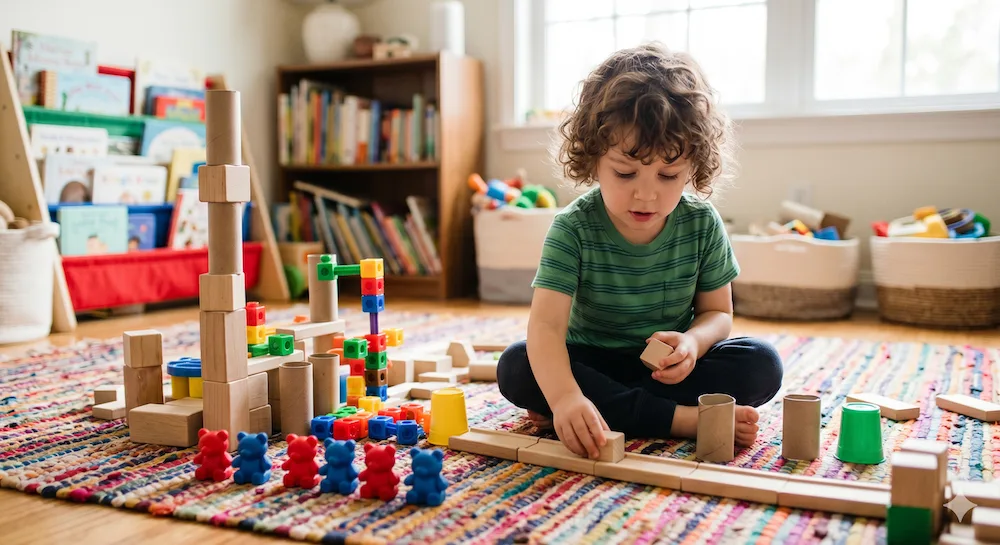
These skills are not a checklist. They blend constantly. A preschooler building a marble run is decomposing the structure, recognizing which ramp shapes work, abstracting the idea of "downhill," and sequencing the pieces. They are doing all four at once and calling it playing.
This is the part that often gets missed in parenting content: kids do not need a screen, a class, or even a special toy to build computational thinking. They need open-ended time, a few materials, and an adult who is curious about their thinking. Bers and her colleagues describe coding as a playground precisely because the same things that make a playground good for kids — autonomy, exploration, problem-solving, social interaction — are what build these skills. The playground does not require coding.
You Are the Expert on Your Child
Here is what no research paper can tell you: which of these skills your specific kid will gravitate to, when they will be ready for more, and how to read the line between stepping back and stepping in. You know your child. You know the signs that they are about to figure something out, and the signs that they are about to fall apart. Trust that.
If a particular suggestion in this article does not fit your kid, skip it. If something we did not mention is lighting them up, lean into it. The science is helpful as a backdrop. You are the one in the room.
Frequently Asked Questions
At what age should I start teaching computational thinking?
You already have. Computational thinking begins forming in infancy, with babies tracking patterns in speech and routines as early as eight months. There is no formal start age. The skills develop through everyday play, conversation, and repetition.
Do I need to teach my child to code to build computational thinking?
No. Coding is one way to practice computational thinking, but it is not the only way. Researchers like Marina Bers emphasize that play-based, unplugged activities build the same foundational skills, and for kids under six, those activities are often more developmentally appropriate than a screen.
What screen-free activities build computational thinking best?
Pretend play, cooking together, sorting and matching games, songs with predictable patterns, building with blocks or recycled materials, and giving your child the chance to direct routines. The best activity is usually whatever holds their attention long enough for them to think.
How is computational thinking different from regular problem-solving?
Computational thinking is a specific style of problem-solving that emphasizes breaking things down, finding patterns, focusing on what matters, and sequencing steps. Regular problem-solving is broader. The four skills together are a particular toolkit, and they are useful in school, in life, and yes, eventually with technology.
Is my child behind if they do not seem interested in this stuff?
Probably not. Kids show their thinking in wildly different ways, and a child who is deep in pretend play, stuck on one beloved book, or busy taking apart your tupperware drawer is doing this work in their own way. If you have genuine concerns about your child's development, your pediatrician is the right person to talk to.
A Quick Note from Puffling
If you are looking for ideas matched to your child's age, interests, and what you already have at home, that is exactly what Puffling is for. Every activity is grounded in early-learning research, designed to be screen-free, and built to fit into real days. Computational thinking does not need a curriculum. It needs a kid, a parent, and a little bit of time.
Ready to make playtime magical?
Get personalized play ideas for your child in seconds.
Download Free