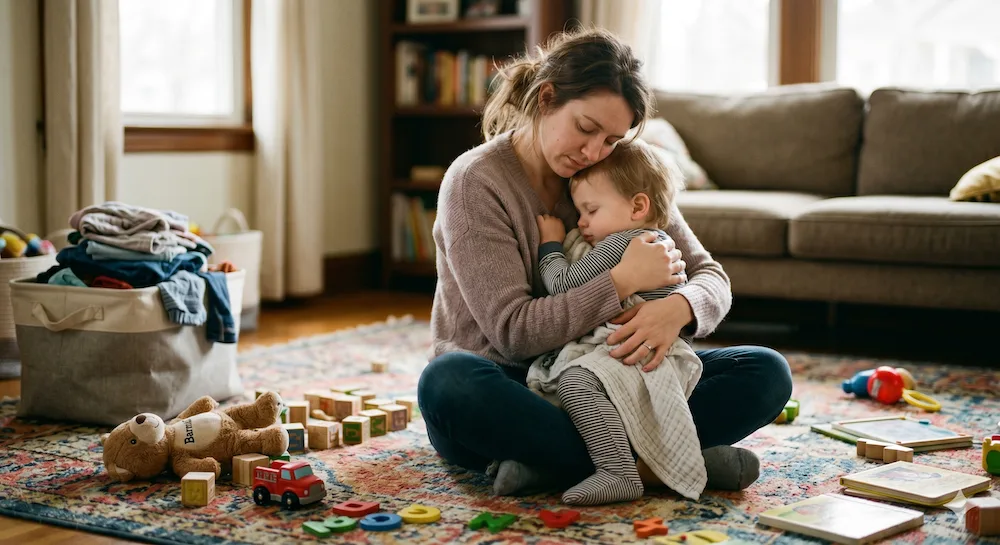
How Families Can Cope With Stress Together: A Research-Backed Guide for Parents of Kids 0-6
If you have been feeling like parenting right now is harder than it should be, you are not imagining it, and you are very much not alone. In 2023, nearly half of parents surveyed by the U.S. Surgeon General said they felt overwhelmed most days. The former Surgeon General, Vivek Murthy, was so concerned about what he was seeing that he formally declared parental stress a public health issue.
So before we get into any research or any tips, let us start here: if you have been white-knuckling it lately, that is a signal about the load you are carrying, not a verdict on you as a parent.
This post is about what the science actually says about family stress when kids are little, and about the small, doable things that research suggests can genuinely help. No guilt, no twenty-step morning routine. Just a calm look at what works.
The Short Version
- Chronic stress can shape children's development in lasting ways, but adversity is not destiny.
- Young kids rely on the adults around them to help them make sense of stress, which means your own coping — even imperfect coping — is one of the most powerful tools they have.
- Small interventions like a few minutes of slow breathing, a short walk, or a quick call to a friend can make a real difference.
- Acknowledging hard things, rather than hiding them, helps young children process and heal.
What the Research Says About Family Stress and Young Kids
A recent review published in the Annual Review of Psychology, led by Dr. Nicki Bush at the University of California, San Francisco, analyzed 153 studies on stress and child development. The findings, summarized in a Greater Good Magazine interview with Bush, paint a clear picture: high levels of stress in a child's environment can affect their brain development, their relationships, their learning, and even their physical health.
When children are stressed for a long time, their biological stress response system stays activated. That system is incredibly useful in short bursts — it is the reason humans have survived as a species — but it is not designed to be turned on indefinitely. Bush explains that kids living with chronic stress may become hypervigilant about possible threats, react with anger to neutral situations like a friendly question, or get physically sick more often. Conditions like asthma can flare because the body never gets enough downtime to repair.
This is heavy information. It is also not the whole story.
The Good News: You Are the Buffer
Here is the part of Bush's research that gets less airtime, and that matters most for parents of young children: kids rely on caregivers to help them interpret what is threatening and what is not. Especially when they are little, your child's stress response is shaped in real time by yours.
This is sometimes called co-regulation. When a parent manages their own stress in a reasonably healthy way, the child is more likely to feel safe — and they are also learning, by watching you, how this whole "being a human with feelings" thing is done.
You do not have to be calm all the time. No parent is. The research suggests that what matters is the overall pattern: are you, on most days, modeling some version of "I am stressed, here is what I am doing about it"? That is the lesson that lands.
Small Things That Actually Help
One of the most encouraging things Bush emphasizes is that coping does not have to be a heavy lift. Most parents of young kids do not have a spare hour for a yoga class or the budget for a weekly therapist. The research backs up smaller interventions:
- A few minutes of slow breathing
- Listening to a song that lifts you
- A short walk, even around the block
- A quick call to a friend to talk something through
None of these require special skills, equipment, or a partner who can hold the baby for an hour. The idea is not to eliminate stress — that is impossible — but to take the volume down enough that you have a little more bandwidth for whatever is coming next.
The "Reset Moment" Before Pickup
Bush singles out one specific window as especially valuable: the few minutes right before you collect your child from daycare, preschool, or a caregiver. If you can give yourself any kind of pause then — a song in the car, three slow breaths in the parking lot, a moment of standing still before you walk in the door — you arrive with a little more capacity to meet whatever mood your kid is in.
You know your child. You know the difference between the day they come barreling at you grinning, and the day they fall apart the second they see your face. Walking in with even a sliver more bandwidth makes both of those landings softer.
Co-Regulation: Your Calm Is Their Calm
For kids ages 0–6, co-regulation is not a parenting buzzword. It is a developmental fact. A baby cannot self-soothe through a wave of distress without help. A toddler in a tantrum is not strategizing — their nervous system is genuinely overwhelmed and looking for a steadier nervous system to borrow from. A preschooler having a meltdown about the wrong color cup is not being manipulative. Their thinking brain has gone offline.
What helps in those moments is not a lecture about feelings. It is your presence, your tone, and your willingness to stay close while the storm passes. That does not mean you have to feel calm. It means you are doing your best to act calmly. Sometimes those are very different things, and that is okay.
A few small co-regulation moves that research supports:
- Get down to their eye level
- Soften your voice (even when you do not feel soft)
- Name what you are seeing: "You are so frustrated"
- Let the moment be the moment — talk about it later, when their brain is back online
You are not failing if this does not work every time. No one is calm with their kid 100 percent of the time. The goal is not perfection. It is a pattern your child can learn from.
Talking About Hard Things, Even With Young Kids
When something genuinely difficult happens in a family — a divorce, a death, a serious illness, a job loss, a scary news event — many parents instinctively want to protect young children by not talking about it. Bush's research suggests the opposite is often more helpful.
Acknowledging what happened, in age-appropriate language, validates what your child is already sensing. Kids notice when the adults in their world are upset, even when no one says a word. Pretending nothing is wrong can actually make young children feel less safe, not more, because they are picking up on something they do not have the words for.
You do not need a script. For a child under six, something like this is often enough:
"Things have been hard lately, and you might have noticed Mommy is sad sometimes. That is okay. We are okay. You can ask me anything."
You can keep checking in over time. You do not have to get the whole conversation right in one go.
Building the Buffer: Relationships Outside the House
One of the most consistent findings across the research Bush reviewed is that supportive relationships — with grandparents, friends, teachers, caregivers, and neighbors — can buffer kids from the effects of adversity. The technical phrase is "social support," but the lived version is much simpler: the more loving adults a child has in their orbit, the better.
This is true for parents too. The single hardest thing about raising kids 0–6 in this era is how isolated many parents are doing it. If you can build even small pockets of community — a text thread with another parent, a regular Saturday at the same park, a neighbor who will hold the baby for ten minutes — you are building protection for both of you.
When to Reach for More Support
Sometimes the load is bigger than what small interventions can hold. If your child has been through major trauma, or if you are noticing signs of ongoing distress — sleep that does not settle, big behavioral changes, ongoing physical symptoms, persistent anxiety — reaching out for professional support is not an overreaction.
Bush mentions trauma-informed approaches like Child-Parent Psychotherapy, which work with the parent and child together and have research support for improving children's behavior, mood, and even biological stress markers. In some states, including California, families can access this kind of care through insurance, and some programs do not require a formal diagnosis to start.
If you are struggling as a parent, your own care matters too. Your pediatrician, your primary care doctor, or a therapist who works with parents can all be good starting points. Asking for help is not a failure. It is a strategy.
You Are the Expert on Your Child
Here is what no research review can tell you: which of these ideas will fit your kid, your family, your week. You know whether a "reset moment" before pickup sounds doable or laughable today. You know whether your child needs you to name the feeling out loud, or whether they need you to just sit nearby and be quiet.
Take what is useful. Leave what is not. You are not behind because you cannot do all of this. The fact that you read this far is evidence that you are paying attention to the thing that matters most — your child and your relationship with them.
Frequently Asked Questions
How does parental stress affect young children?
Children under six rely on adults to help them interpret what is threatening and what is not. When parents are chronically stressed, kids can pick up on it and may experience more activation of their own stress response systems. The good news is that when parents model healthy coping — even imperfectly — children learn from it and tend to feel safer.
What is co-regulation, and why does it matter for kids 0–6?
Co-regulation is the process by which a child borrows a parent's calmer nervous system to settle their own. Young children cannot self-soothe through big emotions reliably. They develop that skill over years, with the help of trusted adults. For ages 0–6, co-regulation is the foundation that later self-regulation is built on.
How can busy parents actually manage stress when there is no time?
Research suggests small interventions matter: a few minutes of slow breathing, an uplifting song, a short walk, or a quick call to a friend. Dr. Nicki Bush specifically highlights the few minutes before picking your child up from daycare or school as a high-value window for a reset.
Should I hide my stress from my young child?
Hiding stress completely is usually not possible — and according to research, not necessarily helpful. Young children often sense when something is off. Naming what is happening in simple, age-appropriate language ("I am having a hard day, and I am taking some breaths to feel better") helps kids feel safe and teaches them how coping works.
Is my child going to be okay if our family has been through a hard time?
Most likely, yes. Researchers consistently emphasize that adversity is not destiny. Many children are remarkably resilient, especially when they have at least one steady, loving adult to lean on. If you have specific concerns, a pediatrician or family therapist is a good first call.
A Quick Note from Puffling
When you and your child have time to play together — even briefly — that is one of the most protective things in your week. Puffling helps make those moments easier by giving you age-matched, research-backed activity ideas using what you already have at home. No prep, no extra subscription boxes, no scrolling for ideas at 6 a.m. Just one less thing on your plate, so you have more capacity for the things only you can give.
Ready to make playtime magical?
Get personalized play ideas for your child in seconds.
Download Free