What Is Child-Led Play? How to Encourage It at Home
My 4-year-old spent 20 minutes last week sorting rocks by size on our back porch. Nobody asked him to do this. Nobody handed him a worksheet. He just found the rocks, decided they needed organizing, and got to work, narrating his logic the entire time.
"This one is medium-small, Mom. That's different from small-medium."
It was, objectively, the most productive learning he did all day. And I almost interrupted it to suggest we go inside and do the craft I had planned.
I share this because I think a lot of us hear "child-centered discovery" and picture something that belongs in a Reggio Emilia classroom with a light table and a trained educator. Something we're not quite qualified to pull off at home, especially when we're also trying to get lunch on the table and keep our 2-year-old from eating dirt.
But child-centered discovery is simpler and more accessible than it sounds. The research is clear on what it is, why it matters, and how any parent can make room for it. Here's what I've learned from digging into the research and from watching my own two boys, still figuring it out day by day.
What "Child-Centered" Actually Means
The National Association for the Education of Young Children (NAEYC) defines developmentally appropriate practice as methods that promote each child's optimal development and learning through "a strengths-based, play-based approach to joyful, engaged learning." The most recent edition of NAEYC's position statement on developmentally appropriate practice emphasizes the need for "active engagement through play, exploration, and inquiry in ways that support the whole child."
In plain language: children learn best when they're active participants, not passive recipients.
Child-centered discovery at home means creating the conditions for your child to explore, question, and figure things out on their own terms, with you nearby as a guide rather than an instructor. It doesn't mean you're hands-off. It means you're paying attention to what your child is interested in, and then leaning into it.
NAEYC's principles of child development describe this beautifully. They note that children's play involves three key components:
- Choice — the child's decision to engage and direct the activity
- Wonder — continued exploration and hypothesis-testing
- Delight — the joy that comes from making discoveries
When all three are present, deep learning is happening, whether it looks "educational" or not.
Why Discovery Beats Direct Instruction for Young Kids
One of the most striking studies in early childhood research comes from MIT and Harvard. In a 2011 study published in Cognition, researchers Elizabeth Bonawitz and Laura Schulz gave preschoolers a new toy. When an adult explicitly taught children one function of the toy, the kids played with it for less time and discovered fewer of its hidden features. When children were simply given the toy without instruction, they explored longer, tried more things, and found more on their own.
The researchers called this "the double-edged sword of pedagogy." Direct instruction is efficient. It gets a specific piece of information across quickly. But it also signals to children that there's nothing left to discover. They stop exploring because the adult has implied, by demonstrating one function and stopping, that there's nothing more to find.
At home, this plays out in small ways every day. When my older son asks, "Why does the ice melt?" I have to resist the urge to launch into a full explanation about states of matter. Instead, the research suggests I'm better off saying, "What do you think is happening?" or "What could we try to find out?" Not because I'm withholding information, but because the act of wondering and testing is where the real cognitive work happens.
Young Children Are Already Wired for This
If it feels like your preschooler asks "why?" approximately 400 times a day, you're not far off. Research by Michelle Chouinard, published as a monograph by the Society for Research in Child Development, found that children under five ask an average of 76 information-seeking questions per hour. (One child in the study clocked 145 questions in a single hour.)
These aren't random. Children ask questions to fill specific gaps in their understanding. Chouinard's research showed that when children didn't get a satisfying answer, they kept asking. They rephrased. They tried a different angle. They weren't being difficult. They were doing exactly what scientists do: seeking information to resolve uncertainty.
Research on curiosity in early childhood from Dr. Jamie Jirout at the University of Virginia connects this directly to learning. Curiosity, she and her colleagues argue, combines the power of active learning and intrinsic motivation with the value of explanatory content. When a child is genuinely curious about something, their brain is primed to absorb and retain information more deeply than when the same content is delivered through instruction.
The takeaway for parents: those relentless questions are not interruptions. They are invitations. When you can, accept them.
What This Looks Like in a Real Home (Not a Catalog)
I want to be honest. My house does not look like a discovery-learning environment most of the time. There are Cheerios on the floor and a pile of unfolded laundry on the couch. But child-centered discovery doesn't require a curated playroom. It requires a few intentional habits, and they're smaller than you might expect.
Follow the child's interest, even when it's boring to you.
My 2-year-old is obsessed with opening and closing things. Lids, doors, latches, boxes. It's repetitive and not exactly stimulating for me. But he is building fine motor skills, learning cause and effect, and developing persistence. I try to let him do it without redirecting him to something I find more interesting.
Ask questions instead of giving answers.
When your child brings you a bug and says, "What's this?" try, "What do you notice about it?" before you Google it together. The NAEYC principles emphasize that educators (and parents) can "encourage children's continued exploration and discovery" by building on children's questions rather than closing them down with answers.
Narrate what you see, not what you want.
Instead of "Great job!" try describing what's happening: "You used all the blue blocks on the bottom and the red ones on top. Tell me about that." This kind of descriptive feedback helps children become more aware of their own thinking, which researchers call metacognition, and it's one of the building blocks of executive function.
Resist the urge to fix or finish.
If the tower falls, let it fall. If the drawing doesn't look like a dog, it doesn't need to. A conversation between NAEYC experts about play in early childhood describes child-centered learning as moments when "a child is driving her experience while the teacher is in the background." At home, you are that teacher, and sometimes your best move is to stay in the background.
Set the stage, then step back.
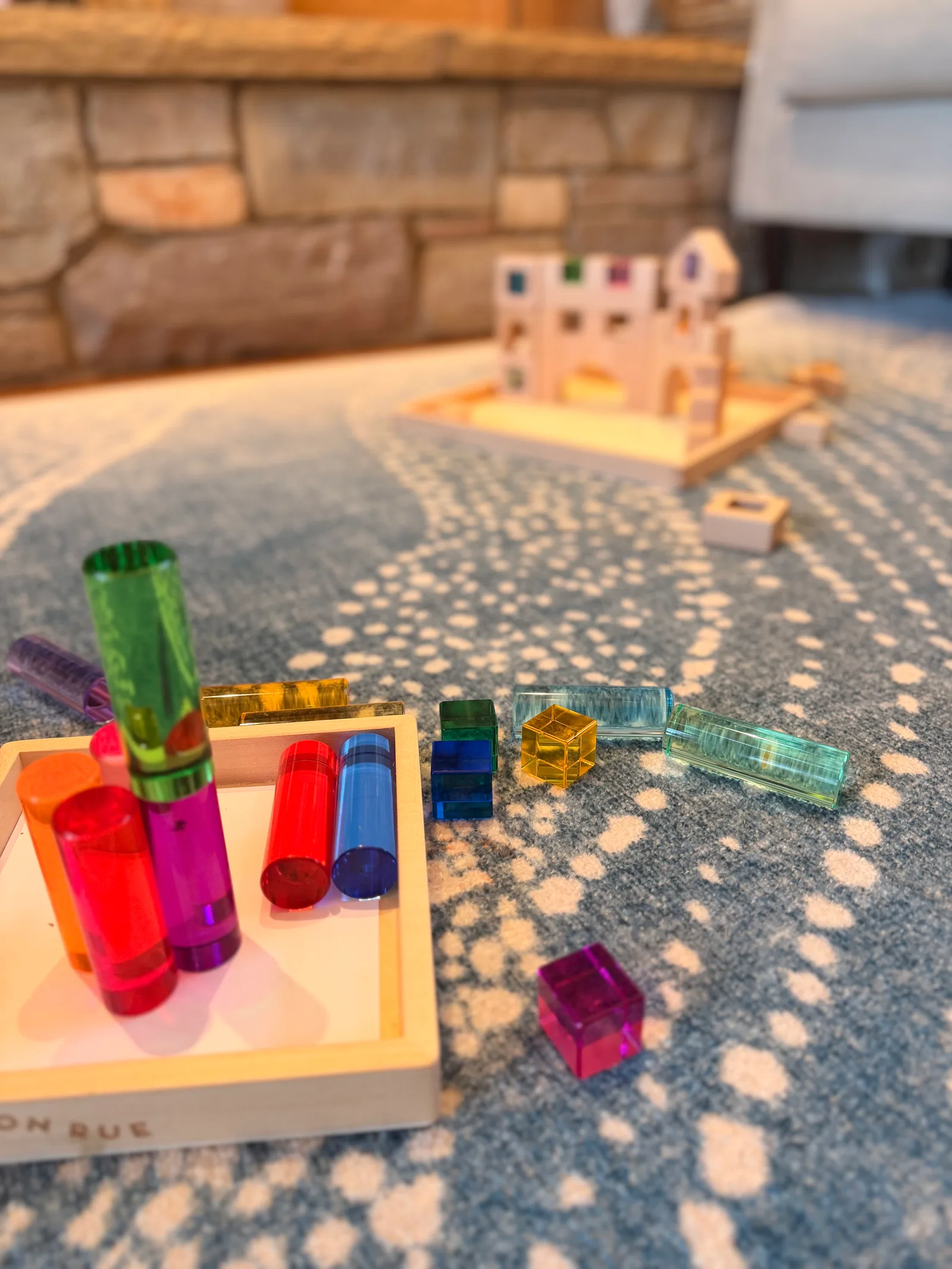
Put out materials. Create a provocation. Fill a bin with water and give your toddler some cups and spoons. But don't tell them what to do with it. The learning is in the doing.
Discovery and Guided Play Are Not Opposites
One of the things that's helped me most as a parent is understanding that child-led discovery and adult-guided play are not in competition with each other. They're partners.
The research on guided play from Dr. Kathy Hirsh-Pasek and Dr. Roberta Golinkoff at Temple University and the University of Delaware shows that the best learning happens when adults set up the environment and offer gentle scaffolding, but the child retains agency within it. You can plan an activity — sorting colored pasta, say, or matching animal figures to pictures — and still let your child take it in their own direction.
In fact, the NAEYC's position statement on play describes this as a continuum, not a binary. On one end is entirely child-directed free play. On the other is direct instruction. In between is a wide space where child-centered discovery lives alongside guided play, and both are valid, effective, and appropriate depending on the moment.
At our house, this looks like me setting up a painting activity and then letting my 4-year-old decide to paint the table instead of the paper. That wasn't my plan. But he was engaged, he was experimenting, and he was learning about what surfaces hold paint and which ones don't. (And I was learning about which household cleaners actually work.)
Why It Matters Beyond the Living Room
Children who grow up with space to explore, question, and direct their own learning develop what researchers call intrinsic motivation — the internal drive to learn because it feels good, not because someone is watching or offering a reward.
Research on curiosity in early childhood education connects this motivation directly to long-term outcomes. Children who are curious and internally motivated show deeper engagement with learning, better retention, and more resilience when things get hard.
But here's the finding that stuck with me most: research shows that children's expressions of wonder, including their own questions, decline dramatically once they enter formal schooling. In school, teachers ask the questions. By kindergarten, curiosity episodes drop to just two to five during a two-hour stretch, compared to the dozens children experience at home in a single hour.
That means the years before school — the ones you're in right now — are the years when your child's curiosity engine is running at full speed. You don't need to build that engine. It's already there. You just need to avoid throwing sand in it.
Let them sort rocks. Answer their 76th question. Put out some water and cups and see what happens. The discovery is already underway.
Puffling.AI helps parents of children 0 to 6 find simple, developmentally rich activities that meet kids where they are. Because sometimes the best thing you can plan is room to explore.
Sources & Further Reading
- National Association for the Education of Young Children (NAEYC). "Developmentally Appropriate Practice (DAP) Position Statement."
- NAEYC. "Defining Developmentally Appropriate Practice."
- NAEYC. "Principles of Child Development and Learning and Implications That Inform Practice."
- NAEYC. "A Conversation About Play."
- Bonawitz, E., Shafto, P., Gweon, H., Goodman, N.D., Spelke, E., & Schulz, L. (2011). "The Double-Edged Sword of Pedagogy: Instruction Limits Spontaneous Exploration and Discovery." Cognition, 120(3), 322–330.
- Chouinard, M.M. (2007). "Children's Questions: A Mechanism for Cognitive Development." Monographs of the Society for Research in Child Development, 72(1).
- Jirout, J.J. (2020). "Supporting Early Scientific Thinking Through Curiosity." Frontiers in Psychology, 11, 1717.
- Weisberg, D.S., Hirsh-Pasek, K., Golinkoff, R.M., et al. (2016). "Guided Play: Principles and Practices." Current Directions in Psychological Science, 25(3), 177–182.
- Harvard Center on the Developing Child. "What Is Executive Function?"
- The Cognitive Science and Neuroscience of Young Children's Curiosity. "Bridging Research and Practice." Exchange Press.
- Bager-Charleson, S. & Dewaele, J.M. (2023). "A Systematic Review of Curiosity and Wonder in Natural Science and Early Childhood Education Research." Journal of Research in Childhood Education.
Ready to make playtime magical?
Get personalized play ideas for your child in seconds.
Download Free