Reggio vs. Montessori vs. Waldorf vs. Forest School vs. Traditional Preschool: What's Actually the Difference?
If you've ever found yourself deep in a preschool research rabbit hole at 11pm, you're not alone. The early childhood education landscape is full of philosophies with passionate followings and strong opinions. This guide breaks down the five most talked-about approaches, what each one actually looks like in practice, who tends to thrive in each environment, and what questions to ask when you're trying to figure out the right fit for your child.
If you've recently started researching preschools, you've probably encountered a dizzying array of terms. Reggio-inspired. Montessori-based. Waldorf. Nature-based. Play-based. Traditional. Each one comes with its own devoted community, its own Pinterest aesthetic, and its own set of claims about what's best for young children.
The truth is, there's no universally "best" approach. Each philosophy reflects a genuine set of values about how children learn, what childhood is for, and what role adults should play in that process. The right fit depends on your child, your family's values, and honestly, what's actually available in your area.
Here's a clear-eyed look at each one.
Montessori
The core idea: Children are naturally motivated to learn and are capable of directing their own education when given the right environment and materials.
Montessori classrooms are immediately recognizable: low shelves, beautiful wooden materials, mixed-age groupings, and children working independently or in small groups at their own pace. The teacher (called a "guide") observes carefully and introduces new materials when a child is ready, rather than delivering lessons to the whole group at once.
Everything in the environment is intentional. Materials are designed to be self-correcting, meaning a child can figure out on their own if they've made an error, without needing an adult to tell them. There's a strong emphasis on practical life skills: pouring, sweeping, buttoning, food preparation. Order and independence are highly valued.
Who tends to thrive here: Children who are self-directed, focused, and enjoy working through things on their own. Kids who are energized by mastery and like to repeat activities until they've fully figured them out.
Worth knowing: Quality varies enormously. "Montessori" is not a trademarked term, so any program can use it. Look for teachers with AMI or AMS credentials and classrooms that reflect the actual methodology.
Reggio Emilia
The core idea: Children are capable, curious, and have "a hundred languages" for expressing their understanding of the world. Learning emerges from their interests, relationships, and environment.
Reggio Emilia originated in northern Italy after World War II and is less a curriculum than a philosophy of listening. In a Reggio-inspired classroom, teachers follow the children's lead, documenting their questions and observations, and building extended projects (called "provocations") around what the children are genuinely curious about. If a group of kids becomes fascinated with shadows, the teacher might spend weeks exploring light, darkness, and reflection through art, science, storytelling, and construction.
The environment is considered the "third teacher" (after parents and educators), so Reggio classrooms tend to be beautiful, carefully curated spaces filled with natural materials, mirrors, light tables, and documentation of children's work displayed at their eye level.
Who tends to thrive here: Children who are highly verbal, imaginative, and love to collaborate. Kids who get excited about deep-diving into a topic and enjoy expressing ideas through art, building, and storytelling.
Worth knowing: True Reggio schools are rare outside of Italy. Most programs in the US are "Reggio-inspired," which can mean anything from deeply faithful to the philosophy to just having a light table in the corner. Ask teachers how they document children's thinking and how projects get started.
Waldorf
The core idea: Childhood is a sacred developmental period that should be protected from premature academic pressure. Learning should be developmentally appropriate, imaginative, and rooted in rhythm and beauty.
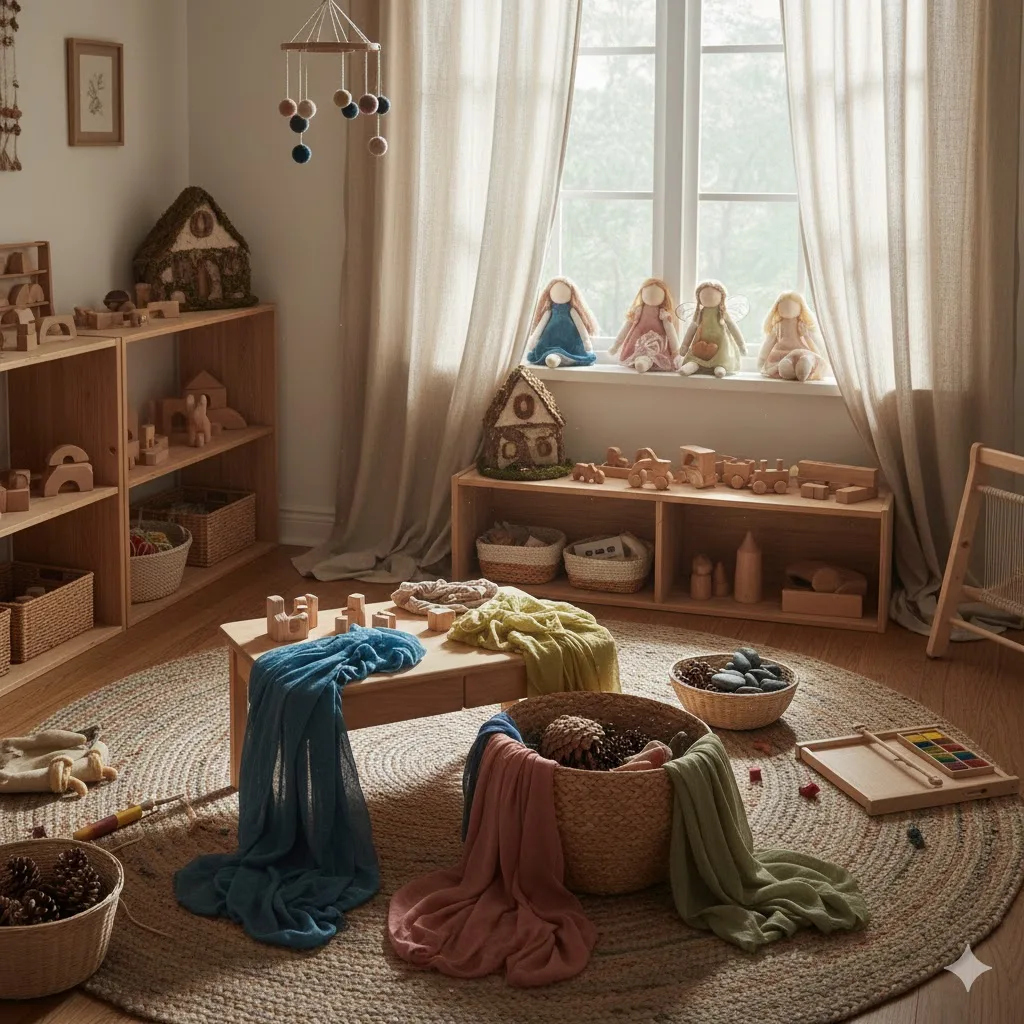
Waldorf education, developed by Rudolf Steiner in the early 20th century, takes a strongly developmental view of childhood. In Waldorf early childhood programs, there is essentially no formal academics. Instead, children learn through imitation, play, art, music, storytelling, and seasonal rhythms. The daily and weekly schedule follows a predictable pattern (a "breathing rhythm" of expansion and contraction) that Waldorf educators believe creates a sense of security and trust.
Toys are made of natural materials: wood, silk, beeswax, wool. Plastic and screens are actively avoided. Fantasy and imaginative play are deeply valued. Children hear fairy tales and seasonal stories rather than factual content.
Who tends to thrive here: Children who are sensitive, imaginative, and thrive with predictable routines. Kids who love creative play and don't respond well to pressure or overstimulation.
Worth knowing: Waldorf has some elements that parents should research before committing, including its roots in Steiner's spiritual philosophy (anthroposophy) and a more cautious approach to academics that some families find too slow. It also tends to have a strong community culture, which can be wonderful or feel insular depending on the school.
Forest School (Nature-Based)
The core idea: Children learn best through direct, unstructured experience in the natural world.
Forest school originated in Scandinavia and has grown rapidly in the US and UK. The premise is simple: get kids outside, give them real tools and real challenges, and let them direct their own learning in a natural environment. Sessions (or full days, depending on the program) take place outdoors in all weather. Children climb trees, build shelters, use tools like hammers and knives (with supervision), tend fires, and explore freely.
Risk is intentionally part of the equation. Forest school educators believe that children need to encounter and manage physical challenge in order to develop resilience, judgment, and confidence. The adult role is to facilitate safety while resisting the urge to over-help.
Who tends to thrive here: Children who are physically active, sensory-seeking, and have a hard time sitting still indoors. Kids who light up outside and may struggle in more structured environments.
Worth knowing: Programs vary widely in quality and philosophy. Some are truly child-led and nature-immersive; others are more like outdoor enrichment with nature themes. Ask how much time is actually spent outside, in what conditions, and how unstructured that time really is.
Traditional Preschool
The core idea: Early childhood is an important time to build foundational academic skills, social competencies, and school readiness.
Traditional preschool programs vary significantly but generally share a more structured approach to the day: circle time, teacher-directed activities, early literacy and numeracy instruction, and a focus on preparing children for kindergarten. Play is still present (especially in quality programs) but tends to be more guided and purposeful than in child-led approaches.
At its best, traditional preschool offers warm, skilled teachers who scaffold children's learning thoughtfully and help kids develop the self-regulation, language, and early academic skills that research shows matter for long-term outcomes. At its worst, it can feel rushed, overly academic for the age group, or focused on compliance over curiosity.
Who tends to thrive here: Children who enjoy structure and clear expectations, who are socially motivated and like group activities, and who are ready to begin building early academic foundations.
Worth knowing: "Traditional" covers an enormous range. A high-quality traditional program with a warm lead teacher and a thoughtful curriculum is a genuinely excellent option. The key is the quality of the relationships and teaching, not just the philosophy on the website.
So How Do You Actually Choose?
A few questions worth sitting with:
- What does your child need more of: structure or freedom? Quiet or movement? Independent work or collaboration?
- What do you value most in early childhood: academic readiness, creative expression, connection to nature, social development, or something else?
- What's the actual program like, not just the philosophy? Visit during a regular school day if you can. Watch how teachers talk to children. Notice whether kids look engaged or just managed.
- And finally: what's available, affordable, and logistically possible for your family? The best preschool is the one your child actually attends, in a community where they feel safe and seen.
Every one of these approaches, when implemented thoughtfully and warmly, can give young children a genuinely wonderful start.
At Puffling, we believe parents shouldn't need a philosophy degree to support their child's development at home. We deliver one simple, research-backed activity each day, tailored to your child's age, so you can feel confident even on the days when everything feels like too much.
Ready to make playtime magical?
Get personalized play ideas for your child in seconds.
Download Free