Toddler Witching Hour: How to Survive the 4 PM Slump
It's 4:17 p.m. The light has changed. Your kid has been mildly losing it for twenty minutes. The chicken is not yet thawed. You have already, against your own rules, said "sure, we can put on a show," because at this exact hour the alternative felt non-survivable.
If that's roughly the scene, hi. The 4 p.m. rut is real, it has a name (in baby world they call it the witching hour, and the witch follows you well into the toddler and preschool years), and it is not a sign you are failing at this. It's the predictable collision of three bodies' worth of biology with the logistical demands of dinner. You're the one who knows whether your kid melts down at 4:00 or 4:45, whether a bath helps or sets them off, whether your version of dinner needs forty minutes or four. Take what's useful here, leave the rest.
Why does 4 p.m. hit so hard?
Three things converge in late afternoon, all biological, all real, none of them about your parenting:
Cortisol is at its daily low. Cortisol, the hormone that helps regulate alertness and stress response, follows a circadian pattern that peaks shortly after waking and declines through the day, hitting its lowest values in the late afternoon and evening.1 In adults, this is the well-documented 3 p.m. slump that has us reaching for a second coffee. In young children, whose self-regulation systems are still under construction, the same hormonal drop arrives in a body with fewer tools to manage it.
Blood sugar is low. Toddlers and preschoolers eat small amounts and burn through them fast. Lunch was probably three or four hours ago. The crankiness that arrives at 4:30 is sometimes just hunger wearing a costume.
Sleep pressure has been building all day. Adenosine, the neurochemical that drives the urge to sleep, accumulates the longer a person is awake. This homeostatic process, first described in detail by sleep researcher Alexander Borbély in 1982, is one of the two main systems regulating sleep and wakefulness in humans of all ages.2 A kid who napped at 1 p.m. has been awake again for two and a half hours by 4 p.m., which is a lot for a small brain. A kid who didn't nap is running on fumes. Either way, the regulatory system is taxed and getting more taxed.
Stack on top of this the normal accumulated load that builds in any adult who has been responsible for another human's needs since 7 a.m., and what you have at 4 p.m. is a tired kid with limited capacity being managed by a tired adult with limited capacity, with two more hours until dinner. The math is bad. The math is supposed to be bad.
When you stop reading the 4 p.m. rut as a parenting failure and start reading it as a predictable physiological event, the question changes. It stops being "what is wrong with us" and becomes "what does our family actually need in this specific window?"
What a 4 p.m. activity needs to do (it's not the same as a 10 a.m. activity)
A morning activity can be expansive, novel, energizing. A late-afternoon activity has a different job. The kid in front of you needs different things, and so do you. A useful 4 p.m. activity tends to:
Lower the temperature, not raise it. Stimulating, novel, high-energy activities at 4 p.m. often backfire. Your kid is not under-stimulated; they're over-stimulated and under-regulated. New isn't the goal. Calm is.
Tolerate a low-bandwidth parent. You should not have to invent anything. The activity needs near-zero setup, ideally happens in or near the kitchen, and doesn't require your continuous performance.
Buy real time, not five-minute tokens. The goal is thirty to forty-five minutes of relative calm, enough that dinner can become a thing.
Make room for connection. Five minutes of full presence at 4 p.m. — lap time, eye contact, a shared small task — often resets a melting kid faster than a half hour of solo distraction. Counterintuitive, and true.
Seven activities that work in the 4 p.m. window
1. The kitchen helper job (real, not pretend)
Ripping lettuce, washing potatoes, stirring something, peeling a clementine, pressing the buttons on the rice cooker. Toddlers and preschoolers want to be useful and to do something with you, not be entertained by you. A kid who feels included in the dinner project is a kid who is co-regulating without you having to script it. The bar is "the dinner happened." That's the whole bar.
2. A bath at 4:30 p.m.
Yes, before dinner. Warm water is a regulation tool: it slows breathing, lowers the nervous system, and asks almost nothing of you. Sit on the bathroom floor with a glass of water and your phone. Let them play. You will feel weird about it the first few times. Then it will just become a Tuesday thing.
3. Audio without screens
Maybe the most underused tool in the 4 p.m. arsenal. An audiobook, a kid podcast (Circle Round, Story Pirates, and Wow in the World are good starting points), or just music. Their brain gets input, their eyes rest, and you get to chop onions. Audio is the closest thing to a parent's secret weapon in this window because it gives the kid a story to disappear into without giving them a screen.
4. The "4 p.m. box"
A bin or tote, kept in a closet, that only comes out between 4 and 5. Stickers, a small pad of paper, two cheap stamp pads, a bag of pom-poms, three small toys they haven't seen in a couple of weeks. Novelty is the trick, and the reason it works is exactly that they don't see this stuff the rest of the day. Rotate it every few weeks. Cheap, low effort, surprisingly effective.
5. A walk around the block
Even five minutes. Fresh air resets a fraying nervous system in both directions (theirs and yours) faster than almost anything else, and you don't need to make it a "real" walk. "Let's go check the mail and come back" counts. The doorway is the threshold; once you're outside, the meltdown often just ends.
6. A water activity at the kitchen sink
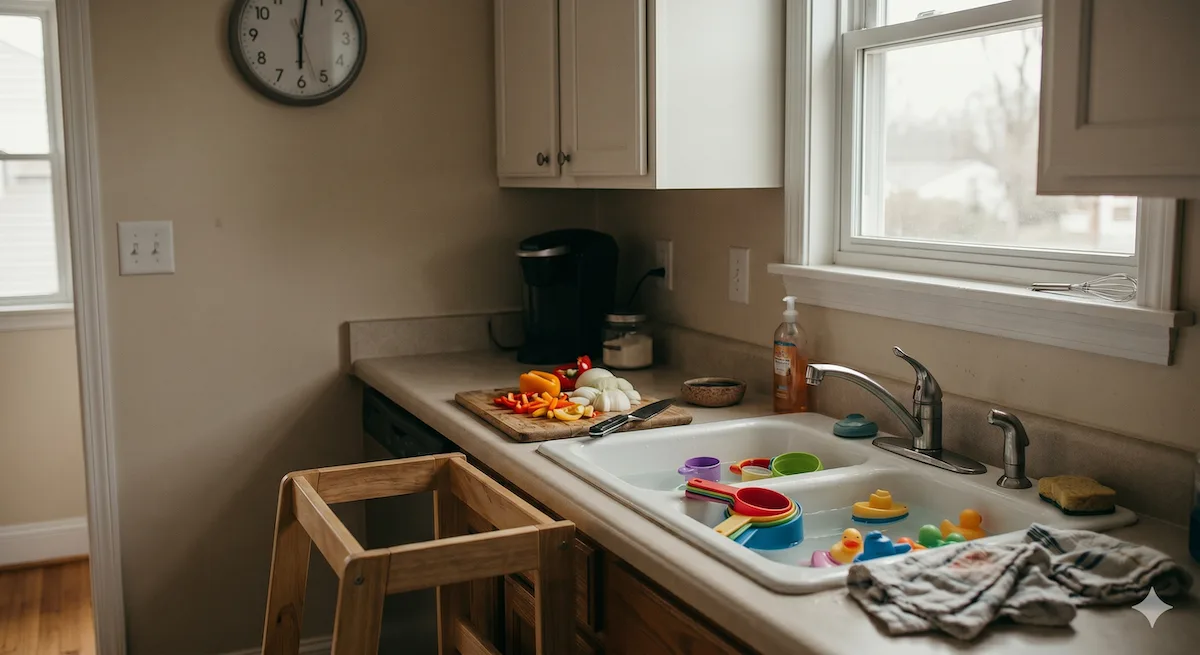
Pull a stool or chair up to the sink. Fill it with a few inches of warm water. Add a couple of cups, a measuring spoon, a whisk, maybe a drop of food coloring if you're feeling generous. Towels under the chair. Your kid is now regulating with water while you cook three feet away. There is research suggesting that toddlers playing with traditional, open-ended materials hear and produce more language during play than kids playing with electronic toys.3 A sink full of water with a few cups is exactly that kind of material. Free, available, working.
7. Lap time with a single book, on repeat
This is the connection move. Five minutes on the couch, reading the same short book three or four times. It feels like it shouldn't be enough. It often is. Toddlers love repetition because they're consolidating language and prediction; what feels redundant to you is doing real cognitive work for them. And five minutes of co-regulated, eye-contact time at 4 p.m. tends to reset a melting kid for the next hour better than any activity you could engineer.
How do I survive the 4 p.m. to dinner stretch?
If you're hitting this rut every weekday, the activity is part of the answer and the dinner system is the other part. A few small things help disproportionately:
Prep the activity setup at 3:50, not at 4:05. Ten minutes of setup before the witching hour starts is the difference between a successful 4 p.m. and a failed one. Setting up the water sink or the sticker session while a meltdown is already in progress doesn't work.
Pick a dinner that doesn't need you the whole window. Sheet-pan things, slow-cooker things, breakfast for dinner, frozen ravioli with pesto. The most ambitious dinner of the week should not happen at 4 p.m. on a Tuesday. Save it for the weekend.
Move dinner earlier if you can. A 5 p.m. dinner with a 3-year-old is sometimes the entire unlock. The kid is hungry, the activity window is shorter, and the witching hour gets cut off at the knees.
Front-load a snack at 3:30. A small protein-and-carb snack — cheese and crackers, peanut butter on apple, a hard-boiled egg — at 3:30 catches the blood-sugar drop before it shows up as behavior at 4:15.
What about screens at 4 p.m.?
The honest answer: 4 p.m. is when most parents reach for a screen, and the American Academy of Pediatrics' guidance of no more than an hour a day of high-quality programming for kids ages 2 to 5, ideally co-viewed when you can swing it, is a useful north star rather than a moral test.4 If a thirty-minute show during the witching hour is what makes dinner happen on a Wednesday, that is not a parenting failure. The point of having other tools in the drawer isn't to remove screens; it's so the screen is one tool among several instead of the only one. On the days when it's the only one available, fine. Tomorrow is another 4 p.m.
A small reframe to take with you
The 4 p.m. rut is one of the most consistent, predictable, biology-driven challenges in life with young kids. Naming it for what it is — a body problem and a logistics problem, not a personal failure — is most of the work. Having two or three low-effort, low-stimulation, near-the-kitchen activities ready for that specific window is the rest.
You're already the expert on your kid. The goal of a piece like this isn't to tell you what to do; it's to take a few decisions off your plate at the hour when decisions are hardest.
If you want a daily nudge with ideas like these, tailored to your kid's age, the time of day, and what's already in your house, that's what we built Puffling for. The 4-to-5 stretch is exactly when invention is hardest. We can do it for you.
Ready to make playtime magical?
Get personalized play ideas for your child in seconds.
Download Free