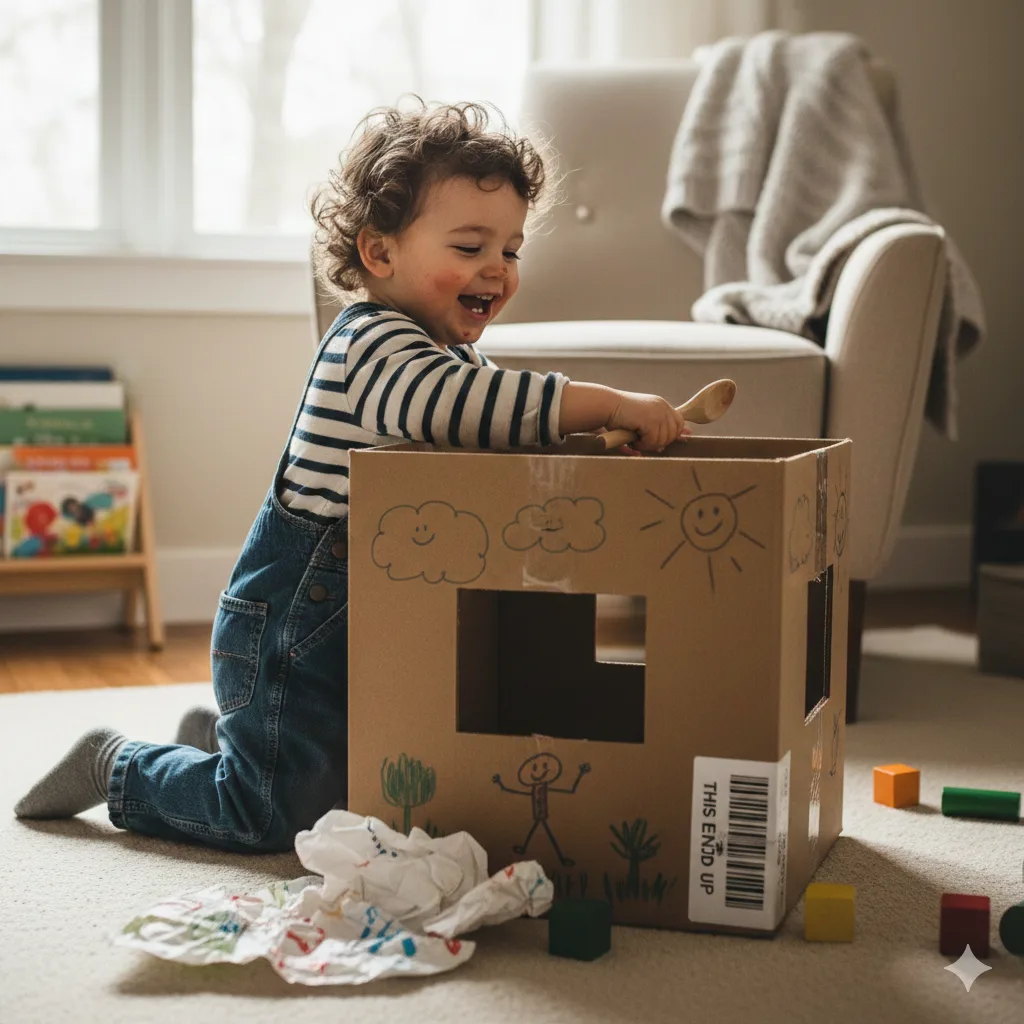
Cardboard Box Activities for Kids: 10 Brain-Building Ideas
Key Takeaways
- Open-ended play wins: Research shows cardboard boxes spark more creative thinking than single-purpose toys because children must imagine the possibilities themselves.
- Every age benefits: From tummy time tunnels for babies to elaborate forts for preschoolers, cardboard play adapts to each developmental stage.
- Free is better: Your Amazon delivery box offers the same developmental value as expensive open-ended toys—often more, because it is fully customizable.
- Skills built: Cardboard play develops spatial reasoning, fine motor control, imaginative thinking, and collaborative problem-solving.
- No prep required: Most of these activities need zero supplies beyond the box itself.
Why Developmental Experts Love the Humble Cardboard Box
There is a reason the cardboard box was inducted into the National Toy Hall of Fame in 2005. While toy stores overflow with flashing buttons and scripted play patterns, that empty Amazon box sitting in your recycling offers something irreplaceable: unlimited possibility.
When a child looks at a cardboard box, their brain has to do the work. Is it a spaceship? A cozy reading nook? A turtle shell? This kind of open-ended thinking is exactly what builds neural pathways for creativity, flexible problem-solving, and abstract reasoning—skills that serve children far beyond the playroom.
The American Academy of Pediatrics emphasizes that play is essential for healthy brain development, and the best play is child-directed. A cardboard box, unlike a toy with predetermined functions, puts your child fully in charge of the narrative.
10 Brain-Building Ways to Play With a Cardboard Box
1. The Classic: Car, Boat, or Spaceship
Ages: 18 months to 6 years
Skills: Imaginative play, narrative development, gross motor (climbing in and out)
Let your child climb into a large box and decide where they are going. Add paper plate steering wheels if you like, but the magic happens when children narrate their own adventures. Exclaiming things like "We are blasting off!" builds language skills alongside imaginative thinking.
2. Tunnel Crawl
Ages: 6 months to 4 years
Skills: Gross motor development, spatial awareness, cause and effect
Open both ends of a box and lay it on its side. For babies doing tummy time, place a toy at the far end as motivation. Toddlers love crawling through and playing peek-a-boo. Connect multiple boxes for an epic tunnel system.
3. Art Canvas
Ages: 12 months and up
Skills: Fine motor control, creative expression, color recognition
Flatten a box for a giant drawing surface, or keep it intact and let your child decorate all sides. Crayons, markers, stickers, paint—anything goes. The beauty of cardboard? Zero pressure about ruining expensive art supplies.
4. Quiet Hideaway
Ages: 12 months to 6 years
Skills: Self-regulation, emotional processing, independent play
Add a blanket and pillow inside a large box to create a cozy retreat. Children often use these spaces to decompress, look at books, or simply enjoy having a space that feels like theirs. This supports healthy emotional regulation and the ability to seek calm independently.
5. Post Office or Store
Ages: 2 to 6 years
Skills: Social-emotional learning, turn-taking, early math concepts
Cut a window in the front of a box to create a counter. Your child can sell items, mail packages, or take orders. This dramatic play builds social scripts, introduces early economics concepts, and creates natural opportunities for sibling or friend cooperation.
6. Sensory Discovery Box
Ages: 6 months to 3 years
Skills: Sensory processing, fine motor skills, cognitive development
Cut various sized holes in a closed box and let little hands reach in to discover hidden treasures (soft toys, textured balls, safe household items). This builds tactile discrimination and the cognitive skill of identifying objects without sight.
7. Ball Drop
Ages: 8 months to 2 years
Skills: Object permanence, hand-eye coordination, cause and effect
Cut a hole in the top of a box just large enough for balls to drop through. Babies and young toddlers are fascinated by making things disappear and reappear—this is them mastering object permanence, a crucial cognitive milestone.
8. Dollhouse or Garage
Ages: 2 to 6 years
Skills: Spatial reasoning, fine motor skills, narrative play
Turn a shoebox on its side for instant small-world play. Add cardboard dividers for rooms, draw on windows and doors, or create a multi-level parking garage for toy cars. Children learn to plan, construct, and adapt their designs.
9. Building Blocks
Ages: 12 months to 6 years
Skills: Engineering concepts, problem-solving, physics understanding
Collect boxes of various sizes for stacking, knocking down, and rebuilding. This is early engineering in action. Children learn about balance, stability, weight distribution, and the satisfying physics of controlled destruction.
10. Fort or Playhouse
Ages: 3 to 6 years
Skills: Collaborative problem-solving, planning, architectural thinking
The ultimate cardboard project: connect multiple large boxes with tape to create an elaborate fort. Cut windows, add a mail slot, create a doorbell with a cup and string. Children who build forts learn to plan, negotiate with siblings or friends, and see a project through from concept to completion.
Tips for Cardboard Box Success
Start with just the box. Resist the urge to immediately add craft supplies or direct the play. Give your child 10-15 minutes with an undecorated box first. You might be surprised what they come up with on their own.
Rotate boxes in and out. A box that has been sitting in the corner for weeks loses its magic. Store boxes flat and reintroduce them periodically for renewed interest.
Follow your child's lead. If they want to use the spaceship as a dog bed, that is perfectly valid play. The learning happens in their choices, not in matching your vision.
Involve them in destruction too. When the box is falling apart, let your child help tear it up for recycling. This teaches the full lifecycle of materials and removes any preciousness about the creation.
The Bottom Line
Next time a package arrives, resist the urge to immediately break down the box. That humble cardboard container offers your child exactly what their developing brain craves: open-ended possibility, full creative control, and the chance to transform the ordinary into the extraordinary.
The best toys are not always the ones with batteries and instructions. Sometimes, they are the ones that arrive holding something else entirely.
Want more simple, science-backed play ideas delivered to your phone? Puffling sends you one curated daily activity matched to your child's age and developmental stage — no overwhelming lists, no expensive supplies. Just one doable idea to make today count.
Ready to make playtime magical?
Get personalized play ideas for your child in seconds.
Download Free