Toddler Language Development: Just Narrate Your Day
Key Takeaways
- Word exposure matters enormously: Children who hear more language in context develop larger vocabularies, stronger grammar, and better reading comprehension years later.
- Narration builds more than words: When you talk through daily activities, you are also teaching sequencing, cause and effect, emotional vocabulary, and how the world works.
- Context is everything: Words learned during real experiences stick better than words from flashcards or screens because the brain encodes them with sensory and emotional information.
- You do not need special time: Diaper changes, cooking, errands, and chores are perfect narration opportunities—no extra activities required.
- It does not need to be constant: Even occasional narration makes a difference. Quality and connection matter more than talking nonstop.
What Is Narration (And Why Does It Feel So Awkward)?
Narration is simply talking out loud about what you are doing, seeing, or thinking—giving your child a running commentary on the world around them. It sounds like: "Now I am putting the pasta in the pot. The water is really hot—see the bubbles? That means it is boiling." Or: "You are working so hard to get that sock on. Almost there. You did it!"
If you have never done it before, narration can feel deeply strange. You are essentially talking to someone who cannot respond in full sentences, about activities that seem too mundane to mention. It can feel performative, exhausting, or just plain weird.
Here is the reframe that helps: you are not performing. You are letting your child inside your mind. You are showing them how language maps onto experience, how adults think through problems, and how the world is organized. That is not silly — that is profound.
The Science Behind the Chatter
The Word Gap Research
In the 1990s, researchers Betty Hart and Todd Risley conducted a landmark study, recording hundreds of hours of family conversations. They found dramatic differences in how much language children heard — some children heard 30 million more words by age three than others. More importantly, they found that early language exposure predicted vocabulary, language development, and reading comprehension years later.
Recent research has added nuance to these findings. It is not just about quantity—quality matters too. Children benefit most from language that is directed to them (not overheard TV or adult conversations), connected to what they are experiencing in the moment, and part of back-and-forth interaction.
This is exactly what narration provides: language that is personal, contextual, and connected to real experience.
Why Context Supercharges Learning
When your toddler hears the word "hot" while watching steam rise from a pot, feeling warmth from the stove, and seeing you pull your hand back quickly, their brain is not just storing a vocabulary word. It is creating a rich network of associations — visual, sensory, emotional, and linguistic—all encoded together.
This is called "embodied cognition," and it explains why words learned in context stick so much better than words learned in isolation. Your child is not memorizing a definition of "hot." They are building a deep, multisensory understanding that will help them recognize "hot" in new situations, use the word appropriately, and eventually read it with comprehension.
Building the Architecture for Complex Thought
Narration does more than build vocabulary. When you talk through activities, you are modeling the invisible structure of thinking itself. Consider what is embedded in simple narration:
- Sequencing: "First we put on your diaper, then your pants, then your socks."
- Cause and effect: "The tower fell down because it got too tall and wobbly."
- Problem-solving: "Hmm, this lid will not open. Let me try turning it the other way."
- Emotional processing: "You seem frustrated that the puzzle piece will not fit. That is hard."
- Prediction: "I think when we open this door, we will see the backyard."
Your toddler is absorbing these thinking patterns long before they can articulate them. You are essentially giving them the software for organized thought.
How to Narrate Without Losing Your Mind
The goal is not to talk constantly—that would be exhausting for both of you. The goal is to weave language naturally into your existing routines. Here are approaches that work:
Sportscaster Mode
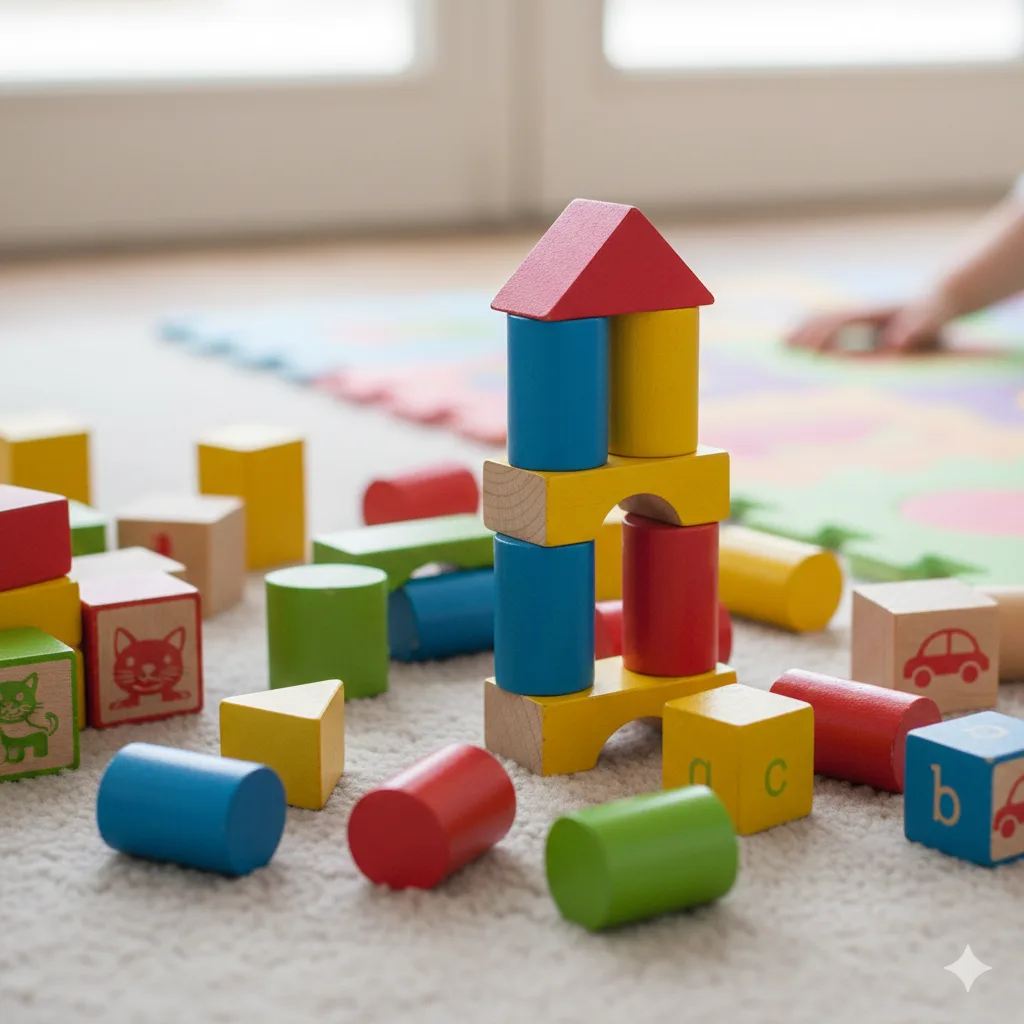
Describe what your child is doing, like a friendly sports commentator. "You picked up the red block. Now you are putting it on top of the blue one. Oh, you are building a tall tower!" This is especially powerful because it tells your child that you see them and that their actions matter. It also gives them language for their own experience.
Self-Talk
Narrate your own actions and thoughts. "I am looking for my keys. Where did I put them? Let me check my bag. Not there. Maybe on the counter? Yes, here they are!" This gives your child a window into adult thinking — including how we handle small frustrations and solve everyday problems.
Routine Anchors
Pick a few daily routines where you will consistently narrate: diaper changes, meals, bath time, getting dressed. Having designated "narration times" means you do not have to sustain it all day. Even ten minutes of rich language input during these routines adds up significantly over time.
The Expansion Technique
When your toddler says something (or points, or gestures), expand on it. If they say "truck," you might respond: "Yes, a big blue truck! It is driving so fast down the street. I wonder where it is going." You are validating their communication while adding new vocabulary and concepts.
What To Actually Talk About
If you are staring at a pile of laundry wondering what on earth to say, here are categories that work well:
- What you see: Colors, shapes, sizes, quantities. "Look at all these oranges. One, two, three oranges. They are round, like balls."
- What you are doing: Actions and their purposes. "I am folding this towel. I fold it in half, then in half again, so it fits in the drawer."
- What comes next: Sequence and prediction. "After we finish breakfast, we will brush teeth, then get dressed, then go to the park."
- How things feel: Sensory and emotional experiences. "This water is warm. Does that feel nice on your hands? You seem relaxed."
- Why things happen: Cause and effect, explanations. "The ice cream is melting because it is hot outside. Cold things melt when they get warm."
- What you wonder: Curiosity and open questions. "I wonder why that bird is singing. Maybe it is calling to its friends."
Permission to Be Quiet
Here is something the parenting advice industry often forgets to mention: you do not have to narrate constantly. Silence has value too. Children need quiet time to process, to develop their inner voice, and to initiate their own thoughts and play.
Narration is a tool, not an endurance test. Use it when it feels natural, during transitions, or when you notice your child is attentive and engaged. Skip it when you are exhausted, when they are deeply focused on independent play, or when you simply need a few minutes of mental quiet.
The research on language exposure looks at cumulative input over time — not whether you talked during every single diaper change. Consistency matters more than perfection.
The Unexpected Benefit: Narration Helps You Too
Many parents discover that narration changes their own experience of caregiving. When you describe what you are doing, mundane tasks become slightly more interesting. When you name your child's emotions, you become more attuned to them. When you talk through problems out loud, you model calm problem-solving—which actually helps you stay calmer.
Narration can also ease the loneliness that sometimes accompanies caring for a pre-verbal child. You are not just completing tasks in silence — you are in conversation, even if the responses are babbles and gestures for now.
The Bottom Line
You do not need flashcards, apps, or special educational programs to give your toddler a language - rich environment. You just need to let them in on what is already happening—the pasta boiling, the socks going on, the blocks falling down.
Every time you narrate your day, you are giving your child a gift: the words to name their world, the patterns to organize their thoughts, and the deep security of knowing that someone sees them and thinks they are worth talking to.
That is not silly. That is powerful.
Looking for more simple ways to boost your toddler's development during everyday moments? Puffling sends you one daily activity matched to your child's age — no prep required, no extra time needed. Just small, science-backed ways to make the ordinary extraordinary.
Ready to make playtime magical?
Get personalized play ideas for your child in seconds.
Download Free