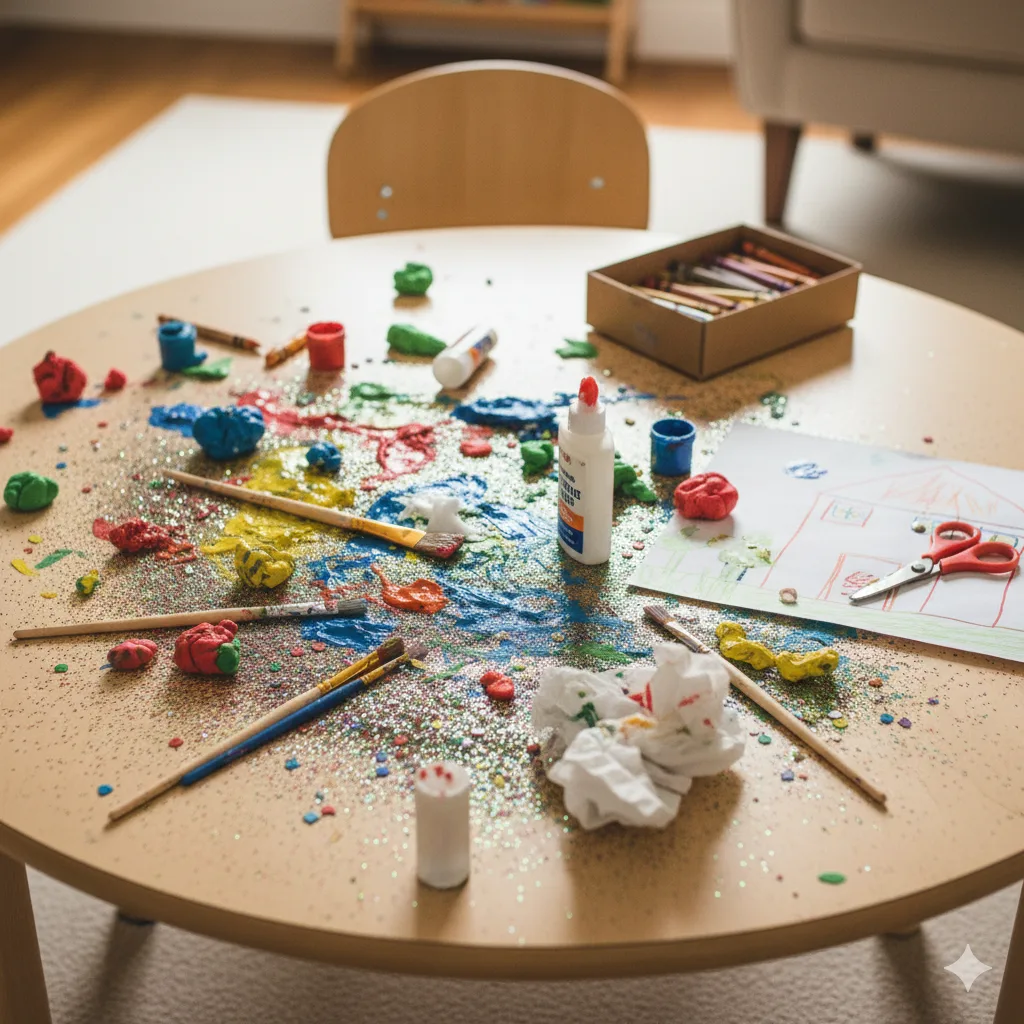
Why Your Toddler Does Not Need Flashcards (And What to Do Instead)
Key Takeaways
- Toddler brains are wired for play, not memorization: Young children learn through exploration, relationships, and hands-on experience—not rote drilling.
- Flashcards can actually backfire: Research shows early academic pressure can increase anxiety and decrease motivation to learn later.
- Conversation beats drilling: Back-and-forth talk with a caring adult builds more language and cognitive skills than any flashcard set.
- Play IS learning: When toddlers stack blocks, pour water, or pretend to cook, they are building the exact neural pathways that support later academic success.
- You are already doing it right: Reading together, narrating your day, and following your child's curiosity are the gold standard for early learning.
The Flashcard Myth: Where It Came From
Walk into any baby store and you will find flashcards marketed to children as young as three months old. The implicit promise is hard to resist: start early, and your child will get ahead. But this idea is based on a fundamental misunderstanding of how young brains actually develop.
The flashcard approach treats learning like filling an empty bucket—pour in enough facts, and you will have a smart kid. But decades of developmental research tells us something very different: young children's brains are not empty buckets waiting to be filled. They are active construction sites, building complex neural architecture through exploration, play, and relationships.
Here is the uncomfortable truth that the educational toy industry does not want you to know: there is no evidence that flashcards improve long-term learning outcomes for toddlers. In fact, some research suggests they may do the opposite.
What the Science Actually Says
How Toddler Brains Are Wired to Learn
Between birth and age three, your child's brain forms more than one million new neural connections every single second. This is the most rapid period of brain development in the entire human lifespan. But here is what matters: not all connections are created equal, and the brain actively prunes connections that are not reinforced through meaningful experience.
Think of it like this: your toddler's brain is not a computer waiting for data uploads. It is more like a garden, where certain pathways flourish when they are nurtured through rich, multisensory experiences, and others wither when they are not used. Flashcards engage a very narrow pathway—visual recognition and rote memory—while leaving the vast majority of the garden untended.
The Serve and Return Effect
Harvard's Center on the Developing Child has identified "serve and return" interactions as the single most important factor in healthy brain development. This is the back-and-forth exchange that happens naturally when you respond to your child's coos, answer their questions, or follow their gaze to see what has caught their attention.
When your toddler points at a dog and you say, "Yes! That is a big brown dog. He is wagging his tail. I think he is happy!"—that exchange builds more neural connections than a hundred flashcard sessions.
Why? Because learning is happening in context, through relationship, with emotional engagement. Your child is not just memorizing the word "dog." They are learning about size, color, animal behavior, emotions, and the joy of shared discovery—all at once.
The Problem with Early Academic Pressure
Multiple longitudinal studies have followed children who received early academic instruction versus play-based learning. The findings are consistent and, for flashcard enthusiasts, disappointing: children who were drilled early may show short-term gains in specific skills, but these advantages disappear by elementary school. More concerning, some studies show these children demonstrate less enthusiasm for learning and higher anxiety around academic tasks by third grade.
This makes sense when you understand child development. Toddlers are not developmentally ready for abstract symbol manipulation (which is what reading flashcards requires). When we push children to perform tasks their brains are not ready for, we do not accelerate development—we just create stress. And stress hormones actively impair the brain's ability to form new connections.
What Actually Builds Toddler Brains
The good news? The activities that genuinely support cognitive development are free, require no special equipment, and you are probably already doing many of them. Here is what the research supports:
1. Rich, Back-and-Forth Conversation
The science: A landmark MIT study found that conversational turns—not just words heard—predicted language development and brain activity in young children. Kids who engaged in more back-and-forth exchanges showed more activity in Broca's area, the brain region responsible for language production.
What this looks like: Narrate your day together. Ask open-ended questions, even to pre-verbal toddlers. Pause and wait for responses—a babble, a gesture, a look. Respond to their attempts at communication as if they are meaningful, because to their developing brain, they are.
2. Open-Ended Play
The science: Play is the primary mechanism through which children develop executive function—the set of mental skills that includes working memory, flexible thinking, and self-control. These skills are stronger predictors of academic success than early reading or math abilities.
What this looks like: Blocks, containers, sand, water, play dough, cardboard boxes. Materials with no "right answer" that let your child experiment, fail, and try again. Resist the urge to direct or correct—the learning is in the process, not the product.
3. Reading Together (Not Drilling)
The science: Shared book reading is one of the most well-documented supports for language development. But the benefit comes from the interaction around the book—pointing at pictures, asking questions, making connections to real life—not from quizzing children on letters or words.
What this looks like: Let your toddler hold the book, turn pages, and go backwards if they want. Follow their interest. If they want to spend five minutes on one page examining a picture of a truck, that is perfect. Engagement matters more than finishing the story.
4. Sensory Exploration
The science: Toddlers learn through all their senses simultaneously. Multisensory experiences create stronger, more interconnected neural pathways than visual-only learning (like flashcards). This is why children remember experiences so much better than isolated facts.
What this looks like: Cooking together. Playing in dirt. Finger painting. Water play. Exploring different textures. These messy activities are building sophisticated neural networks that support learning across all domains.
5. Following Their Lead
The science: Research on "joint attention"—when adult and child focus on the same thing together—shows this shared focus is critical for learning. Children learn better when they direct the interaction and adults follow, rather than when adults direct and children comply.
What this looks like: Notice what captures your child's attention and join them there. If they are fascinated by how the drain works, spend ten minutes exploring it together. Their intrinsic motivation is doing the heavy lifting of brain-building.
But What If My Kid Loves Flashcards?
Some children genuinely enjoy flashcard-style activities, and that is okay. The issue is not flashcards themselves—it is the pressure, the drilling, and the belief that they are necessary for your child to succeed. If your toddler thinks flipping through picture cards is fun and you are doing it playfully together, no harm done.
The red flags are: structured daily drilling sessions, quizzing for performance, frustration (yours or theirs) when they do not get answers "right," or choosing flashcards over active play because you believe they are more educational. They are not.
The Bottom Line
Your toddler's job is not to memorize. Their job is to explore, experiment, connect, and play. When they dump out a basket of toys for the hundredth time, they are learning about gravity, cause and effect, and spatial relationships. When they ask "why" seventeen times in a row, they are building the neural pathways for scientific thinking. When they insist on doing it "myself," they are developing executive function.
The most powerful thing you can do for your toddler's brain development is also the simplest: be present, be responsive, and let them play. No flashcards required.
Ready to ditch the drilling and embrace play-based learning? Puffling delivers one simple, developmentally-appropriate activity to your phone each day—designed around how toddler brains actually work. Science-backed, parent-tested, and zero flashcards in sight.
Ready to make playtime magical?
Get personalized play ideas for your child in seconds.
Download Free