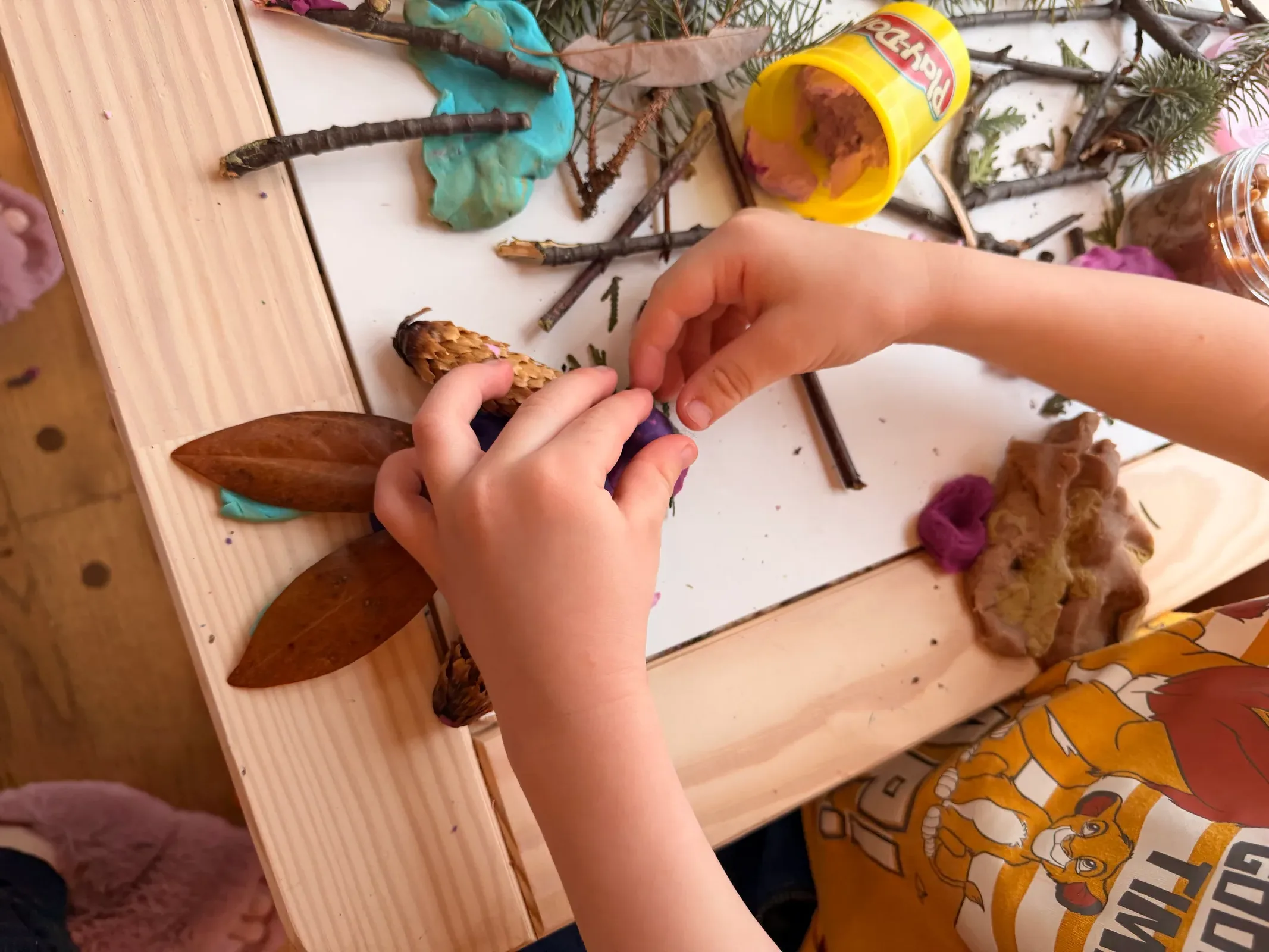
What Is Guided Play? Why 10 Minutes a Day Is Enough
There's a message floating around parenting spaces right now, and it sounds like this: step back. Stop hovering. Let your child lead. You're doing too much.
And honestly? Parts of that message are good. Kids absolutely need unstructured time. They need room to be bored, to explore, to figure things out on their own. No argument there.
But somewhere along the way, "don't over-schedule your kid" became "don't plan anything at all" — and that's where the science tells a different story.
Because here's the thing: a few easy, intentional activities each week aren't helicopter parenting. They're not over-functioning. They're actually one of the simplest, most evidence-backed ways to support your child's development, nurture your relationship, and — plot twist — help your child play more independently, not less.
And you definitely do not need to be a Pinterest parent to do it.
What Do We Even Mean by "Intentional Activities"?
We're not talking about elaborate sensory bins that take 45 minutes to set up and 90 seconds to destroy. We're talking about small, purposeful moments — five to twenty minutes — where you sit down with your child and do something together with a loose goal in mind.
That might look like:
- Tearing up pieces of construction paper and gluing them onto a shape (fine motor skills, focus)
- Playing a simple sorting game with toys they already own (early math, categorization)
- Dancing to a song and then freezing when it stops (impulse control, body awareness)
- Rolling a ball back and forth while you narrate what's happening (language development, turn-taking)
Simple. Short. Often messy. Rarely Instagram-worthy. And backed by decades of developmental research.
The Science: Why a Little Structure Goes a Long Way
Guided play is a developmental sweet spot
Researchers at Temple University and the University of Delaware — most notably Dr. Kathy Hirsh-Pasek and Dr. Roberta Golinkoff — have spent years studying something called "guided play" — the space between free play and direct instruction. In guided play, an adult sets up the environment or introduces an activity, but the child still has agency within it. They make choices, explore, and direct portions of the experience.
The research consistently shows that guided play outperforms both free play and direct instruction when it comes to outcomes like vocabulary acquisition, spatial reasoning, and problem-solving. It's the middle ground where kids learn best — because they have just enough structure to encounter new concepts, but enough freedom to make those concepts their own.
This isn't about controlling your child's play. It's about creating a launchpad.
Serve-and-return interactions build the brain — literally
The Harvard Center on the Developing Child has identified "serve and return" interactions as one of the most critical ingredients in healthy brain development during the first six years of life. These are the back-and-forth exchanges where a child reaches out (a look, a sound, a gesture) and an adult responds in a meaningful way.
Intentional activities naturally create these moments. When you sit down to stack blocks together and your toddler knocks them over with a grin, and you gasp dramatically and say "oh no, the tower!" — that's serve and return. That's neural connections forming in real time.
You don't need a curriculum. You just need to be present and responsive for a few minutes, with some loose idea of what you're doing together.
Short, focused interactions reduce parental stress (really)
This one might seem counterintuitive. How can adding something to your day reduce stress?
Because the alternative — an entirely unstructured day with a young child — is often more draining, not less. Research on parenting self-efficacy has consistently found that parents who engage in regular, brief, positive interactions with their children report lower levels of parenting stress and higher confidence in their parenting abilities.
When you have a short activity planned, you get a little pocket of connection that has a beginning, a middle, and an end. There's no ambiguity about what to do next. You're not staring down an empty afternoon wondering if you're doing enough. You did the thing. It took twelve minutes. It counted.
It actually fosters independent play
Here's the part that surprises a lot of parents: children who get regular doses of engaged, intentional time with a caregiver tend to play more independently afterward, not less.
Why? Because those short bursts of togetherness fill their connection cup. Developmental psychologists describe this as the "secure base" cycle — rooted in attachment theory — where children venture out to explore, return for connection, and venture out again with more confidence. When kids feel securely connected, they don't need to cling. They're free to go off and build their block tower alone for twenty minutes while you drink your coffee.
As the American Academy of Pediatrics notes in its clinical report on play, developmentally appropriate play with parents is a "singular opportunity" to promote the social-emotional and self-regulation skills that build executive function — and those are the exact skills that allow children to sustain focus and play on their own. The investment pays itself back.
It prepares kids for the classroom — any classroom
Whether your family is headed toward a Montessori environment, a play-based preschool, a traditional classroom, or homeschooling, the skills practiced in short intentional activities translate everywhere.
Sitting with a task for a few minutes. Listening to a short set of directions. Tolerating mild frustration when the glue won't stick. Taking turns. Finishing something you started.
These are executive function skills — the cognitive skills that help children plan, focus, remember instructions, and manage impulses. The Center on the Developing Child at Harvard identifies early childhood as the most critical period for building these skills, and they're built through practice, not lectures.
Five minutes of "let's cut along this line together" is executive function training. It just doesn't look like it because it's also fun.
What This Doesn't Mean
Let's be clear about what we're not saying.
This isn't about filling every moment. Free play matters. Boredom matters. Downtime matters. Unstructured play has its own well-documented benefits for creativity, emotional regulation, and physical development. We're talking about a few intentional pockets woven into the rhythms of your week — not a packed schedule.
This isn't about perfection. The craft does not need to look good. The activity doesn't need to go as planned. Your toddler might eat the playdough in the first thirty seconds. That's fine. The value is in the interaction, not the output.
This isn't about buying stuff. Most of the best activities for young children use things you already have — paper, water, spoons, socks, boxes, your voice, your attention.
This isn't about guilt. If you had a day where screens happened and nobody did a single activity, that's a normal day. This is about the gentle, cumulative effect of showing up with a small plan, somewhat regularly. Not about doing it perfectly every time.
The Real Reason It's Worth It
Beyond the developmental research and the brain science, there's something simpler happening when you sit on the floor with your kid and do a five-minute activity together.
You're telling them: I thought about you. I planned something for us. You're worth my time and attention.
Kids feel that. And it changes how they see themselves, how they see you, and how they move through the world.
You're not helicoptering. You're not overdoing it. You're parenting with intention, in small and manageable doses, and the research is clear: it works.
So grab some crayons, put on a song, or dump some dried pasta into a bowl and call it a sensory bin. It doesn't have to be fancy. It just has to be together.
Puffling.AI helps parents of children 0–6 discover simple, age-appropriate activities that support real development — no planning degree required. Because parenting is hard enough without starting from scratch every day.
Sources & Further Reading
- Weisberg, D.S., Hirsh-Pasek, K., Golinkoff, R.M., et al. (2016). "Guided Play: Principles and Practices." Current Directions in Psychological Science, 25(3), 177–182.
- Weisberg, D.S., Hirsh-Pasek, K., & Golinkoff, R.M. (2013). "Guided Play: Where Curricular Goals Meet a Playful Pedagogy." Mind, Brain, and Education, 7(2), 104–112.
- Harvard Center on the Developing Child. "Serve and Return."
- Harvard Center on the Developing Child. "5 Steps for Brain-Building Serve and Return."
- Harvard Center on the Developing Child. "What Is Executive Function?"
- Harvard Center on the Developing Child. "Building the Brain's 'Air Traffic Control' System." Working Paper 11.
- Harvard Center on the Developing Child. "Enhancing and Practicing Executive Function Skills with Children from Infancy to Adolescence." Activities Guide.
- Yogman, M., Garner, A., et al. (2018). "The Power of Play: A Pediatric Role in Enhancing Development in Young Children." Pediatrics, 142(3). American Academy of Pediatrics Clinical Report.
- Crnic, K. & Ross, E. (2017). "Parenting Stress and Parental Efficacy." In Parental Stress and Early Child Development. Springer.
- National Academies of Sciences. (2016). "Parenting Knowledge, Attitudes, and Practices." In Parenting Matters: Supporting Parents of Children Ages 0–8.
- Clay, R.A. (2023). "The Many Wondrous Benefits of Unstructured Play." American Psychological Association.
- Hirsh-Pasek, K. & Golinkoff, R.M. — Play Research Lab at Temple University.
Ready to make playtime magical?
Get personalized play ideas for your child in seconds.
Download Free